Showing posts with label Law School. Show all posts

Monday, October 24, 2011

Young Mr. Lincoln: Legal Drama #7


What a silly fucking movie.  


This movie is Criterion Collection-ed and all, starring Henry Fonda (a good sign) and directed by John Ford (who also directed Stagecoach, The Grapes of Wrath *and* an earlier, very awesome legal drama, The Man Who Shot Liberty Vallance).  To be frank, I was expected a movie, a classic movie, full of guts and gusto and pomp and fury and all of that passion that accompanies our American classics.  What I got was a silly, froofy little movie that made me think weird things about Abraham Lincoln.

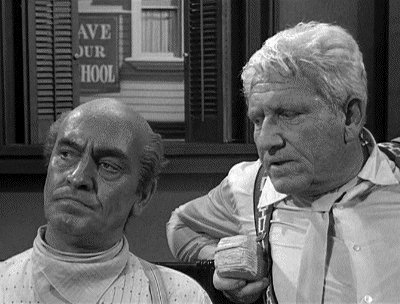
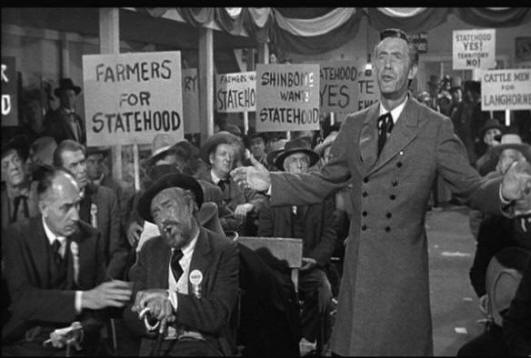
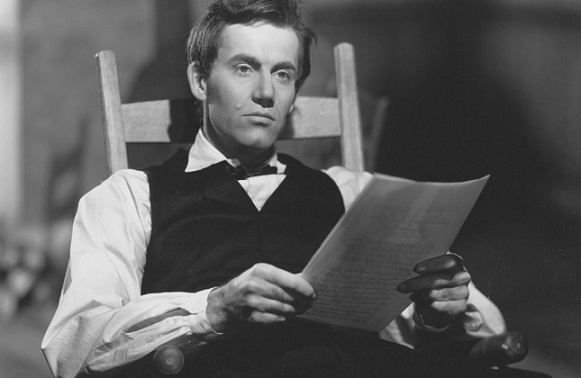
 Every one of the Google Image results for this movie cracks me up.

I suppose a plot synopsis is in order.  Le sigh, fine.  So, Abe Lincoln’s girlfriend-thing dies, and Lincoln gets his hand on a law book and studies law now because of it, and travels to Springfield on a fucking mule and sets up a little law practice, and uses a murder in a brawl as his first case, and commands angry crowds with his oratory about how we can’t hang them right now, they need a fair trial.  He then stuffs a jury with drunks and prances around the courtroom making jokes until he finally decides that the moonlight wasn’t bright enough for the eyewitness account to be considered substantial evidence, and he then tricks the eyewitness into admitting he did it through some sort of logic (although, it is just as equally plausible that there was no logic at all).  Also, there is this really hilarious scene where Abe eats some pie for like a million hours.  Guys, this movie is ridiculous.

 "Sir, I am just making sure you are drunk enough to serve on my jury"

My expectations were so high.  I expected this movie to play to my heartstrings, not to bore me and make me squeal “This is ridiculous!” out loud several times.  This is a real Meet Me In St. Louis, another “classic” that is just too inane and annoying to take even remotely seriously.  I mean, Abraham Lincoln’s whole case is that he makes fun of people on the stand.  At one point, he tricks someone into calling himself a horse’s ass, and is basically “Yup.  I rest my case.  That man is a horse’ass”.  Henry Fonda plays him as cheeky, rebellious and smarmy, feet on the table and all.  It makes you say “Wow.  I guess Abe Lincoln was kind of a jerk?”  

 This is the scene where Abe Lincoln decides he wants to be a lawyer atop a hilltop in a thunderstorm and it cracks me up so very very much.

Nancy Is A Lawyer?
Ha.  This movie uses law only as a prop for a character.  It doesn’t make me think anything about              the legal profession at all.   The judge giggles while Abe Lincoln gets drunkards on the stand.  This movie is essentially a movie about what people in the 1940s thought about people from the 1830s, and from that perspective, yeah it’s kind of interesting.  The 1940s thought the 1830s were filled with a bunch of dummies.  All of the actions – exaltations, shouts, laughs – were highlighted and over-acted.  I can’t believe the judge just giggled when Lincoln called him a horse’s ass?  I guess this film made me want to be a lawyer, because it made me wanna smack my gavel down and yell at Abraham Lincoln.  That’s what being a lawyer means, right?

 Yup.  That's all that being a lawyer means.

Wednesday, September 14, 2011

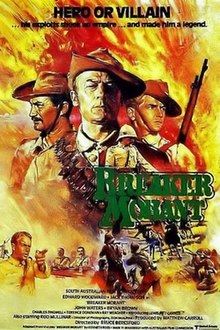
Breaker Morant: Legal Drama #5

Wow.  I was not expected to be as blown away with Breaker Morant as I was.  I had never heard of it before, there was barely any explanation of it in the books I read…it just kept popping up, again and again, without any explanation.  I thought it would be a boring courtroom drama with an easy ending.  Instead, it was a gritty, sad and realistic movie which spent less time engaging in legal fisticuffs than it did questioning the very grounds of justice itself.  Sort of the polar opposite of A Few Good Men.

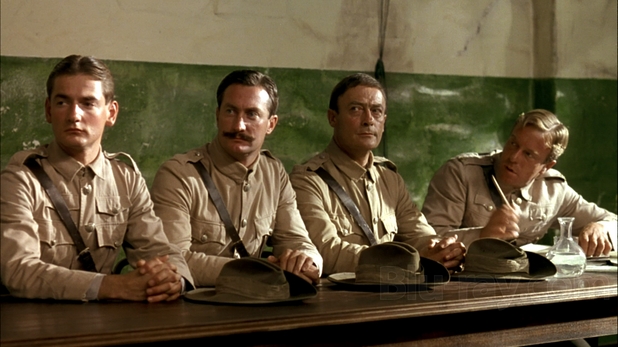
Breaker Morant is a film about an Englishman, Harry “Breaker” Morant, and two Australians stationed in South Africa during the Boer War.  These gentlemen were court-marshaled for their execution of Boer prisoners and one German prisoner.  Lord Kitchener ordered the court marshal in an attempt to quickly and peacefully wrap up with Boer War, and show Britain’s seriousness through its willingness to put its own men on trial.

What I love about this movie is that there is no question about whether or not Morant and his men did it.  They did.  The film skips between the courtroom and them on the field, and watches their story evolve.  You see the rage, confusion and frustration that come through on the battlefield, you sense the dejection and disconnect that these men feel from their cause.  You really feel that there is no explicit evil in these men, but that there are (as the attorney puts it) normal men acting under abnormal circumstances.  The grittiness, the barrenness and the all-and-all boringness of war are felt explicitly (because, ya know, Nancy knows all about what war feels like).  


The conflict in this film lay in the contradiction Britain is enacting.  Lord Kitchener is trying to use his own men as political pawns.  But all of this is completely his doing.  He ordered the executions.  He court-marshaled them to prove a point.  The orders bore his signature, and yet so did the notices for their executions.  This film is not unlike A Few Good Men at its heart, because it is about dutiful soldiers fulfilling their orders and then being reprimanded, and the hypocrisy present in any society that condemns its own men for acting under orders, or even for acting in a way that seemed reasonable to them given the pressures, confusions and degradations of battle.

But it’s way, way better than A Few Good Men.  For one, the men being represented aren’t bland automatons automatically responding with their admiration for their duty and lot in the Army.  Rather, they are complex, fleshy and full characters, who are full of confused duty and have genuine mistrust and questions for the country they are fighting for.  

For two, the focus isn’t on the “crafty lawyer” getting them out of this.  It’s about them.  It’s about people being taken advantage by our justice system and their reactions and questions for that.  

And most importantly, it really, densely explores the “You Can’t Handle The Truth” aspect that A Few Good Men only lightly touches on, and even mocks.  It really delves deeply into the complexity of the confused nature of justice in wartime, and what we can and cannot hold men accountable for.   Furthermore, it hints that we do need that duality of justice; that we need a separate code of laws to do our dirty work for us so we can keep living in our luxury, but we need a different code in that luxury.

The acting is fucking amazing- natural and realistic while still delivering powerful punches.  This movie is full of long shots, beautiful close-ups and landscapes and smashcuts.  It gives it a dry but powerful resonance, with such attention to subtlety that the emotional powerhouse moments are ten times as loaded.  Drinking rotgut whiskey and climbing on tables reciting Lord Byron precedes serious discussions about the density of their sentence.  Serious, long discussions in the courtroom are realistically undercut with sharp sarcastic and cynical jabs by the defendants.  Overall, this movie felt real.

My only complaint is how quickly the story moves.  Possibly because it is such an integral part of Australian history, and this is an Australian film, it is taken for granted that most Australians would know the details.  For example, when Hunt’s crew approaches Devil’s Gorge for the quintessential skirmish that cost Hunt his life and Morant his sanity…I didn’t know that was going to happen.  I didn’t even know Hunt’s character was that big of a deal at that point.  But I presume that if I was Australian, I would.  What I am saying is, this film took quite a bit of rewinding and a bit of outside research to fully comprehend.

I am mad.  I am all full of wine and Australian protest songs I found on the internet.  It’s 1AM and raining outside, and I am feeling more angry and disillusioned at the legal process than I did at the end of To Kill A Mockingbird.  Because the death of Tom Robinson was an icon of racism, a literary construction to illustrate the dangers of racism and the folly of logical justice in the face of human inadequacy.  This film does that too, but it’s not a fucking construction or icon.  Breaker Morant was a real dude, flawed and complex, who acted as a pawn for our system of justice, was extremely taken advantage, and it cost him his life (ack!  spoiler alert) (oh, whatever.  Did you guys know the Titanic sank?).  And there was nothing his attorney could have done in those closed door sessions of military law.  Morant was going to be a political figure for the British, because the iconography these warring nations needed in order to settle their debts was larger and more powerful than any sense of individual justice, and more meaningful than an individual man’s life.

Nancy Is A Lawyer?

Ahhhhhhhhhhhhhh.  
 
The cold hard reality of what actually happens in the real world contrasts my idealizations of Atticus Finch.  Sure, with the correct lighting and intense music and all, I can become empowered by a dutiful failure.  Fought as hard as you can but there’s still racism?  Whelp, dust yourself off and begin again tomorrow.  But in the real world, people get angry and riled-up.  Knowing myself, I wonder if I could selflessly and stoically accept a lost cause.  In this film, our lawyer did not embody the cold determination and reluctant acceptance of human folly that I have come to associate with the Lawyer Cliché.  He was a fucked-up human, just like all the men he was representing.  And he lost.  And he has to deal with losing for the rest of his life.  Not only must he reckon with that in his own personal conscience, but has to deal with living in this world for the rest of his life when he has faced its injustices so explicitly.  

I know, this is a silly thing to realize.  But it really serves as a reminder that if I practice law, I will still be myself.  I will sometimes be a riled-up person faced with grave injustice, and there may very well be nothing that I can do about it.  That might just be the way the world works.  And honestly, I’d like to think I can raise my head like Atticus Finch and carry on with my life.  But at the end of the day, I’d probably be a Major Thomas; I’d probably fight so hard I’d never want to fight again.

Maybe this means I just shouldn’t go into military law?  But any law I could go into, the “good” and the “bad” won’t be explicitly defined.  It’s not as if I can just go into law and represent unions and know that big corporations are the “bad guys” and I’m representing the “workers”.  Life is not as simple as that.  I will always be grappling within a system that is full of grave injustices, and I am not sure if my skin is tough enough to roll with those punches.  I can be spat on, I can be threatened, I can be told that I am scum, sure.  I’m a tough chick.  But that’s all surface; am I tough enough in my very core to recognize how deeply fucked the world is and keep fighting anyway?  That, I am not sure.  A part of me hears that and just wants to get drunk and watch cartoons.

Furthermore (I feel so grown-up when I say furthermore), this film puts into question the very nature of justice.  I touched on this with Liberty Vallance and Mockingbird, but it really cuts to the core here.  Justice doesn’t make any fucking sense.  Human beings are not smart enough to create a pristine and consistent system that isn’t ripe with hypocrisy.  That fact is made even more evident when empires engage in mass genocide in a different context yet penalize a murder done singularly in the parameters of normal society.

I understand contextualizing morality, whatever.  In a very abstract way, it’s a sort of floppy conversation.  But this film really brings the futility of our justice system into full light in a very hard and stern manner.  How can we have two prevailing systems of justice, one in the context of war and another in the context of civilian life?  I mean, I understand that we have to; I’m not disputing that fact at all.  But doesn’t the very existence of these two simultaneous forms of justice just prove that we are all just making this all this shit up as we go along?

Breaker Morant is the first film to make me genuinely nervous about whether or not aspiring for law is a good call.


Thursday, August 25, 2011

A Few Good Men : Legal Film #4


I love Rob Reiner.  I do.  Please disregard all the mean things I’m about to say about him.

Man, Rob Reiner fucked this movie.

                 
Aaron Sorkin’s fantastic writing – sharp and quick, really well-thought out – is paired with Reiner’s “It’s a romantic comedy in New York” style of directing.  How can someone who directs Billy Crystal being New-York-Y-Snarky during falltime direct a tense legal drama?  

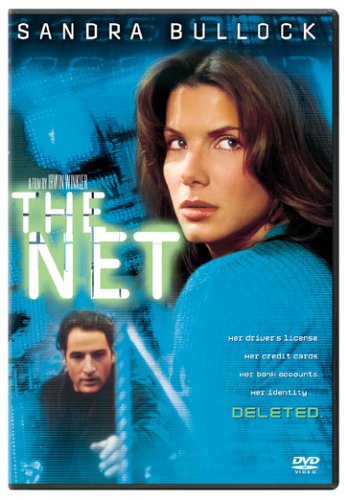
I suppose my problem with it came down to the fact that it should be tense and dry, but Rob Reiner is such a cinematic director.  I know that sounds silly to say, but he certainly includes all the bells and flourishes when it comes to decorating a film – the sharp cut, the dramatic music, the panning-across-a-city, etc.  It found myself shouting “God, this is so from the NINETIES” every ten seconds, because every stylistic choice that I associate with shitty 90s romcoms and The Net was there.  

                                               I wish this movie had a lawyer in it...

But this is a fucking Aaron Sorkin movie!  This is – or at least could be – an incredibly sharp, dry, not-at-all cheesy exploration of justice and legality.  Watching Tom Cruise doing his logical tricks and strut around the courtroom would have been more entertaining if I was so distracted by what a smarmy, jock archetype he was.  Not because of the writing, but the decisions of the director – when to zoom in, when to cut, when to play dramatic music - emphasized all that shit to no end.

                      I do like that Kevin Fish is in this.  That does make it slightly better.

In a nutshell – a pretty fun script with cheesy-as-all-fuck directing.  I wouldn’t put it as a requirement to watch for Great American Movies, but I would suggest watching it if you are an Aaron Sorkin nerd.

                                                            Ladies....


Nancy Is A Lawyer?


This movie is one of the few that everyone shouts when you say the words “legal drama” or “classic courtroom film” or “I really have a weird thing for Jack Nicholson?” which are all words I say often.  

                                                            Aw, yeah.

But I really felt like it had way less to do with the actual legal process or painting law in a realistic way then any of the other movies I’ve watched so far.  It was all pomp and fury of law, and very little actual research and dirty work, which is what I am interested in seeing.  For example, Demi Moore has a ‘sinking suspicion’ that something more went on at Gitmo.  I’m more interested in her work in discovering the sinking suspicion than the courtroom drama.
                 
I understand that films have to be cinematic and engaging.  But honestly, I gleaned nothing real about the legal process from this film.  It also put a huge emphasis on charm and clever manipulation.  Which is certainly part of the legal profession, but I get the impression that you spend about 2% of your time, maybe, like Tom Cruise in this movie.


The only thing this movie did well was the Nicholson monologue at the end, regarding justice    and what we do to preserve our false sense of order.  I would have loved this movie to explore this more, but it was too easy to just paint Jack Nicholson as the bad guy and carry him away.    This movie is all of the showy aspects of law, with very little of the deliberation.  This is possibly why 12 Angry Men is one of my favorite movies – because it is *all* deliberation.

                            This movie is great!  I wish I could talk about it!!!

I mean, I could day dream about changing the world and rehearse court cases in the shower, as I’m sure many folks entering into the legal profession do.  But I am much more attracted to the Finch way of approaching law, which is simply dutifully fettering away and doing your best until  you help one person’s life, as opposed to being on a holy crusade for justice.  It felt like Demi and Tom were standing atop a mountain screaming “This just isn’t…right!” when I feel like law should be a more careful deliberation of what good and bad actually is, and what that means for actual people.  And the only time this film ever comes close to those questions is when Jack Nicholson shouts at Tom for questioning his methods, and reminds him that human law and justice is not as simple as his lawbooks would lead him to believe.  Good point, Jack!  And then he goes to jail forever and ever and Tom and Demi get married and have, like, a million of each others babies.

                                                       Mah-wwage!!!

I did not like this movie.  This movie made me want to be a lawyer to spite it.  


Inherit The Wind: Legal Drama #3


God damn!  This got me all riled up!  For those of you who do not know (ya dummies!), Inherit The Wind is a film based on the Scopes/Monkey trials, starring Spencer Tracy and Fredric March as two dueling attorneys.  March plays the riveting Brady, a religious orator under the guise of a lawyer, who uses linguistic tricks and plays on people’s steadfast spiritual associations to sway the courts.  My boy Tracy plays Drummond, who seeks to defend freedom of thought and acts (at least in the courtroom) as a paragon of logic.


This movie was directed by Stanley Kramer, who is known for directing films with strong, passionate, bleeding-heart liberal messages.  He also directed On The Beach, which I absolutely loved, and Guess Who’s Coming To Dinner?, starring Tracy and his one true lady love, the Ms. Katherine Hepburn.  This film is no exception.  But I get all jazzed up at this one, because the issues addressed in this film are more *fundamentally* ideological.  Beach is about nuclear war and Dinner is about racism, and both are incredibly well-done.  But this film puts on display, the clearest way possible (a courtroom, for chrissakes!), one of the plainest dichotomies between people – those who ride the tide, and those who actually think thoughts.


This film goes into the pomp and circumstance of law – the tricky moments, the getting-riled-up-in-the-courtroom, the passion and dedication and oratory.  It has an absolutely adorable and snarky Gene Kelly as a news reporter whose paper finances Drummonds expensive, and who serves as a TomServo to the entire court case, making sarcastic and snide comments and mocking the religious beliefs of the masses.  There are incredibly powerful and beautiful performances that are, sure, a little ham-handed.  But Spencer Tracy brings such an awesome sincerity to his performance that it more than makes up for the cheese and pomp.  And there is just something about the whole impassioned and riveting ordeal that tingles my heartknobs and rocks my world.


Nancy Is A Laywer?

Inherit The Wind had more of the pomp and circumstance of law, that I have discussed before, that I have shied away from.  But while watching it, there was something neat about at least imagining that there was a truth that I could defend, a sense of pure and unquestionable justice that I could be a part of.

Now obviously, I know there is no pure and unquestionable justice or fairness or truth.  Those are not things that exist in the real world.  But this court case illustrated to me the closest that I might get in my career.  And that is simply this : asking questions is always a good thing.  Self-satisfied awareness and certainty in your base truth is probably not a good thing.

This movie both challenges and utilizes the idea that you can fall back on your base.  Watching Brady tie every question back to his religious core was eerie, because it didn’t take a seconds thought on his part.  Everything came back to his base, his one truth.  At the same time, so did Drummond, but his one truth was that you need to ask some fucking questions in order to understand the world.


Drummond’s truth, for me, is symbolic of the truth of Law in general, *and* it’s a little paradoxical.  I say that because if you are really defending a case, then you have a one truth that you have to tie everything back to.  But you react this truth by drilling it down to it’s core, by consistently asking questions and removing all of the fluff until you reach it’s base.


I should say that I don’t actually imagine myself defending cases in court, but more like helping little old people write their wills or helping a young couple navigate the legal ramifications of purchasing a piece of land next to a national park or something.  Because that’s what law actually is, because people don’t make movies about that, so I have to pretend that Drummond is shouting about Intellectual Property Law or Cruise Ship Accident Law in order to get excited about my future.  So, ya know, perspective.  I know that work in the legal world is excessive hard work and has very little, if anything, to what is shown in this movie.  Cases like this happen once a century.  Watching this movie and saying that you want to be a lawyer is like watching Matlida and saying you want to be a teacher.   


I've always dreamed of being a teacher because I want to watch children make pencils fly with their minds.

But there is something very appealing to be about systematically and thoroughly dismantling the base truths that people use to guide their moral compass, because I truly believe any base truth that is not fluid and subject to change and growth is a dangerous thing.  In that sense, I do believe in a pure and unquestionable justice, but only in that it is questioning.  Allowing yourself to evolve with the new evidence and ideas that are presented to you.  A careful evolution and analysis of propositions is essentially what a trial is.  So, I guess according to my own logic, I *really* want to be a lawyer.  I mean, whether I, as an emotional human being, actually respect the logical conclusions that I reach and execute consistency with my conclusions and actions, will probably be more of a deciding factor of my professions than the shit I write on my blog. But as for now, lawyer away!!!

The Man Who Shot Liberty Valance: Legal Film #2


This is the first movie on my list where quote “Jimmy Stewart plays a small-town lawyer”.  Anatomy Of A Murder marks #2.  However, despite the fact that this film is essentially a tragedy, Jimmy plays a more positive role.  The simplest synopsis would say that this film is about a young lawyer, Rance Stoddard, who travels to Shinbone, a renegade town in the Wild West.  When he gets there, he is accosted by the town ruffian, Liberty Vallance.  Thus begins this fancy pilgrim’s hoity-toity pursuit to build a lawful society in Shinbone, in order to bring Liberty to justice (I am having so much fun writing this recap).  Tom Doniphon, played by John Wayne, stands as the only equal to Liberty in the town, and Tom is skeptical of Rance’s lawfulness and is convinced the only justice that Liberty can understand is with a pistol (Eek I feel so sassy and Western!)


But really, this film is about different conceptions of justice, different balances of lawfulness and a town’s transition from one rule of a law to another.  This movie doesn’t offer any specific conclusion as to what system of governance is best.  But what it does is show the confusion, excitement and nervousness that a town experiences when an outsider comes in and provides a different way of life.


There is something I want to point out regarding Doniphon’s character, who I will now refer to only as John Wayne, because John Wayne is never not John Wayne in any movie.  As I plow through the legal films, I have noticed a certain lawyer cliché emerge.  Namely, the fact that lawyers in film tend to be jaded, detached and cynical.  Rather than rallying with the crowds and shouting prolific oratory, lawyers seem to take deep breaths, look mildly bemused by the human drama but ultimately saddened by what a mess lay before them.  There is a certain demeanor that accompanies this.  In The Man Who Shot Liberty Valance, Stoddard is a young, flailing mess, impassioned and crazy and searching for justice.  John Wayne’s character is the one that embodies that lawyer-y demeanor that I am growing accustomed to seeing in legal dramas.

This makes sense, because he is *used* to his rule of law.  He is the lawyer-figure in the system of justice that Shinborne has.  He is used to its rises and falls, and he understands when one can win and when one cannot.  Stoddard still believes in changing the world.  I think this is very telling, in that it re-enforces that Stoddard didn’t necessarily “save” Shinbone by coming.  It already had a specific rule of law, which Valance and John Wayne were old hat at, and Stoddard didn't understand. 

 
I think systems arise within groups of people.  And in order to prevent these systems from being subject to hatred, prejudice and greed, we codify them in such a way and evolve them with the times.  A strong system had arisen in the town of Shinborn that was not codified, but was still a system.  The absence of established & codified rule and logic is certainly frightening to someone who does not understand it, but no one in that town was necessarily complaining before Stoddard’s appearance.  The rules were just understood.

This movie is very vindicating, but still ends on a somewhat tragic note.  The sadness this film evokes certainly has a lot to do with the analysis of justice this movie offers, and the absence of satisfying conclusion or direct answer.  But this works in its favor.  There is no direct answer to the questions this movie proposed.

Nancy Is A Lawyer? 

This movie actually taught me a lot.  Some of it I knew already, from doing work with people in the political arena.  Mainly, I'm referring to the fact that people are swayed by a common enemy.  You can convince people of everything and anything if you point a finger alongside them.  Secondly, it reminded me how much I value internal consistency.  More and more, I find myself saying lately “I just like it when things make sense”.  Even though the world is chaos, I love it when, in a system, there is just a sense of logic that works within that system, whether or not the system itself holds any real water.  The world of Shinbone before Stoddard’s entrance, there was a sense of justice.  Thus, it made me wince every time Stoddard tried to impose his sense of city-slicker justice, because it did not work within that environment. 


Now, Stoddard’s justice had more of a logical consistency…but that is because it was designed to.  The legal system strives towards being comprehensively internally consistent.  That’s why certain cases setting precedence over other cases is even an issue– if it counted once, it has to count again, because those are the rules, because otherwise our system is broken.  And, ya know, I *do* adore that about man’s codified system of judgement, I really really do.  But there was something so pure and organic about Wild West, terrain law as it arose, something so seductive and logical.  It wasn't internally consistent because it wasn't designed; it just happened.  Obviously, it could not stand the test of time, because it is not a law that can be altered or edited, it is not a rule of law that can bend to the changes in social roles and democracy.  I am getting the inkling that that aspect of law is key to justice.  However, that does not mean I didn’t cringe every time Stoddard did something ridiculously lawful and logical.  I found myself shouting “No!  That doesn’t work here!”


This is not a downside of law, by any means.  This is just an understanding that law does not exist just because we notice it or because we try to act towards it.  Law arises of its own accord.  I think it’s important to realize that it is there, so we can change it and realize that we probably shouldn’t commit mass genocides and that ladies can vote and junk. But a rule of law is not a conscious human creation, but just a manifestation of social contracts.  It arises even without the volition of certain individuals.  It just arose in society because that’s what happens when big groups of people get together and try to figure themselves out.